Find your next move
You don't need to see the whole solution. Start with one number you can explain.
Back to today's puzzle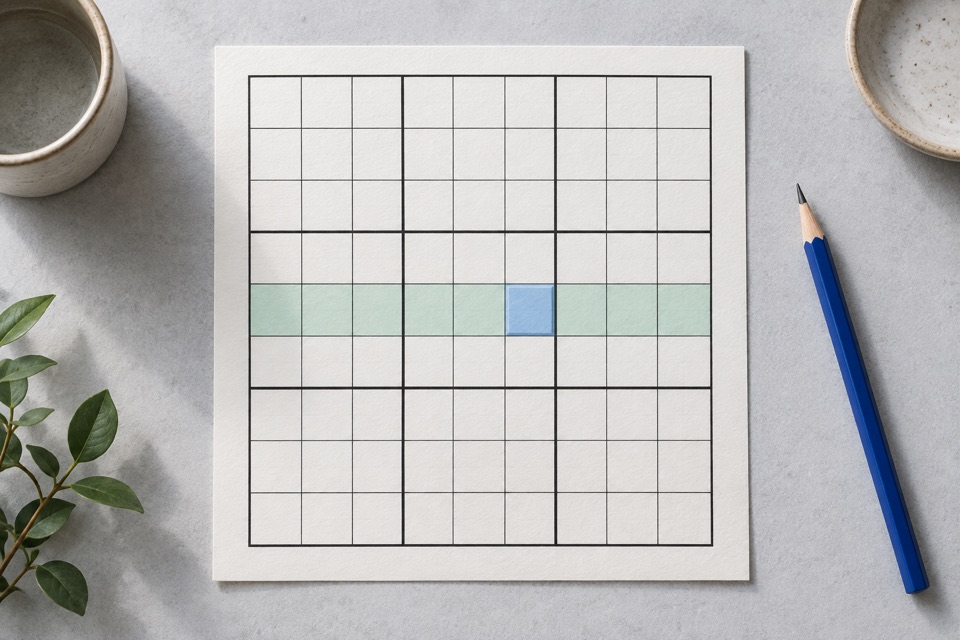
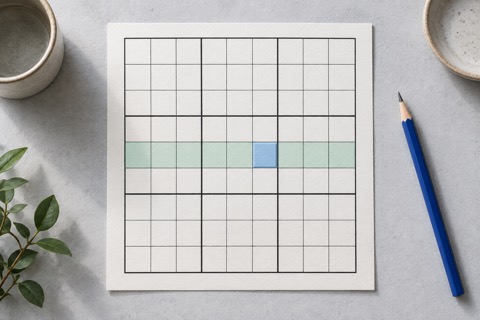
1. Look for the almost-full row
Choose a row, column, or 3×3 box with very few blanks. Name the digits it still needs. With one empty cell, the missing digit is forced.
- 8
- 2
- 5
- 1
- ?
- 4
- 9
- 6
- 3
See the answer & why
7. 7 is the only digit from 1 to 9 missing from this row. In your puzzle, also check that it does not repeat in the crossing column or box.
Try it on your board: scan for a unit with eight numbers. If you cannot find one, a unit with seven numbers gives you just two possibilities to compare with its crossing cells.
2. Check one cell in three directions
An empty cell belongs to a row, a column, and a box. A possible digit must be allowed in all three, not just one. Remove any number already present in those units. One candidate left means you have a naked single.
| Check | Possible digits |
|---|---|
| Missing from the row | 2, 5, 7 |
| Missing from the column | 1, 5, 8 |
| Missing from the box | 3, 5, 9 |
See the answer & why
5. Only 5 appears in all three lists. Every other digit is ruled out by at least one of the cell's row, column, or box. This is a naked single.
You are asking “What can this cell contain?” Write candidates as notes when keeping them in your head becomes awkward. Our pencil-notes guide shows how.
3. Give one number a home
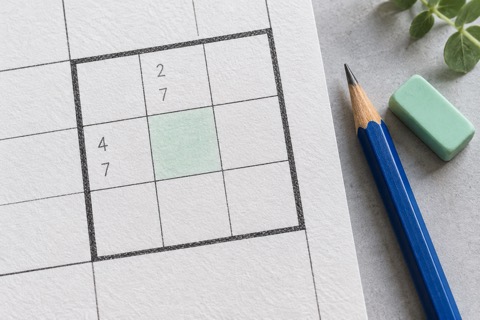
Now reverse the question: “Where can this number go?” Within a single row, column, or box, a digit that fits in only one empty cell has to go there. This is a hidden single, even when that cell has other notes.
| Empty cell | Possible digits |
|---|---|
| Cell A | 2, 7 |
| Cell B | 2, 4, 7 |
| Cell C | 2, 7 |
See the answer & why
4 in Cell B. 4 must go in Cell B: it has no other place in this row. A cell can have several notes and still be forced. This is a hidden single.
Use this only after checking every empty cell in that unit. Incomplete pencil notes can make a number look unique when it is not.
When nothing stands out
Move to another box instead of staring at the same cell. After each placement, recheck its row, column, and box: one new number can make another deduction possible. These beginner checks will not solve every situation, so getting stuck does not mean you missed something obvious.
In DaySudoku, select an empty cell before using Hint. It reveals that cell only. You can also take a break; the puzzle is not a race.
Does a blue number mean my answer is correct?
Are these examples answers to today's puzzle?
Technique reference: Andrew Stuart’s explanation of single candidates. Examples and writing on this page are made for DaySudoku.