Two cells. One useful clue.
Sometimes you can rule a number out before you know where it belongs. A naked pair is a small, satisfying way to do exactly that.
Back to today's puzzle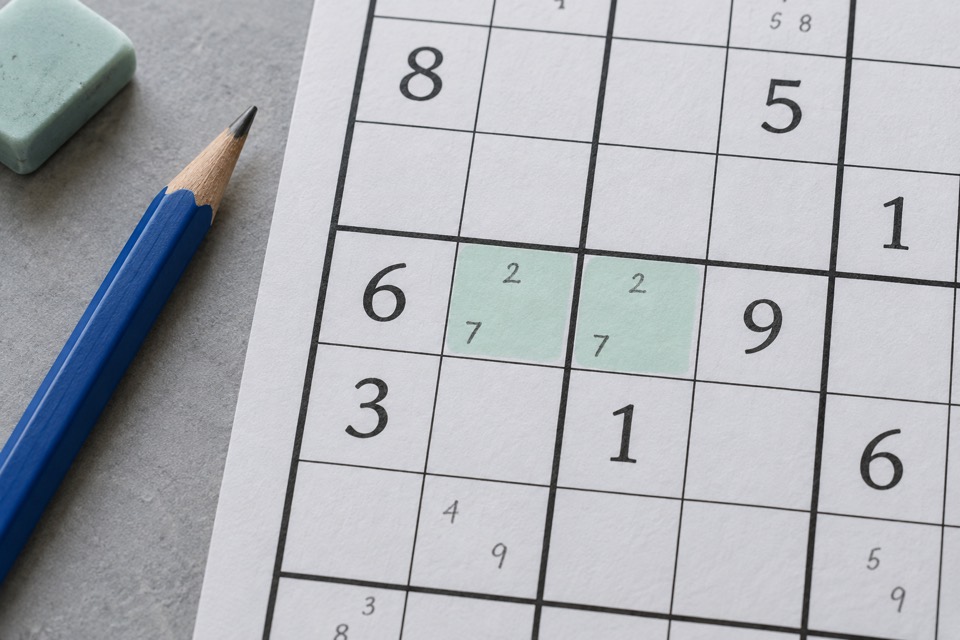
First, trust the candidate lists
A candidate is a digit that has not yet been ruled out. Before looking for patterns, check the cell’s row, column, and box. Include every remaining possibility, not just the two digits you like best. The pencil notes guide is a useful starting point.
The examples below are independent teaching examples, not clues to today’s puzzle. Each table lists all the empty cells in one example row and their complete remaining candidates. Other digits in that row are already filled.
Two cells reserve two digits
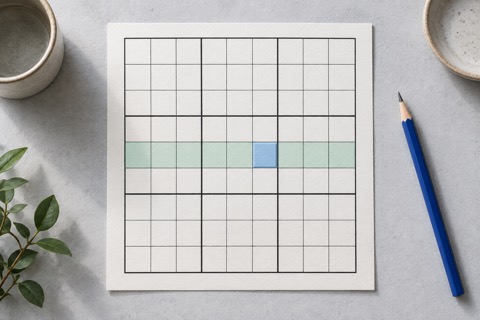
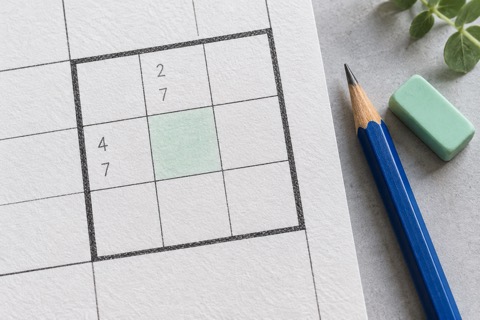
Suppose two cells in the same row, column, or box each have exactly the candidates 2 and 7. One must be 2 and the other 7. You do not know their order, but together they reserve both digits. Remove 2 and 7 from the other cells in that shared unit.
This is a naked pair. It is a candidate-elimination technique, not permission to guess which cell gets which digit. SudokuWiki’s naked candidates reference describes the same rule.
Try it: what can Cell C lose?
| Empty cell | Possible digits |
|---|---|
| Cell A | 2, 7 |
| Cell B | 2, 7 |
| Cell C | 2, 5, 7, 9 |
| Cell D | 5, 9 |
See the answer & why
Remove 2 and 7 from Cell C. Cells A and B reserve 2 and 7 between them, in either order. Cell C is left with 5 and 9; Cell D stays at 5 and 9. No cell has a final answer yet. Do not remove the pair's own notes.
Nothing needs a final number yet. Narrowing Cell C to two possibilities is still progress. Keep the pair’s own notes until another deduction fixes their order.
When a pair creates a single
Sometimes removing the pair leaves another cell with just one candidate. That cell, rather than either member of the pair, gives you the next final number.
Try it: which cell is now forced?
| Empty cell | Possible digits |
|---|---|
| Cell A | 3, 8 |
| Cell B | 3, 8 |
| Cell C | 3, 5, 8 |
See the answer & why
5 in Cell C. A and B must hold 3 and 8. Removing both from C leaves only 5. A and B still need another deduction to determine their order. You could also spot 5 as a hidden single here: C is its only possible home.
After a final placement, check its neighbors again. A small elimination can make an ordinary single-candidate move visible.
The lookalike that does not work
Two cells sharing two notes is not enough. Each must have exactly those two candidates. A third candidate in either cell breaks this particular deduction.
Try it: do A and B form a pair?
| Empty cell | Possible digits |
|---|---|
| Cell A | 2, 7 |
| Cell B | 2, 7, 9 |
| Cell C | 2, 5, 7 |
| Cell D | 5, 9 |
See the answer & why
No: Cell B still allows 9. For example, A = 2, B = 9, C = 7, D = 5 satisfies these candidate lists without repeating a digit. Removing 7 from C would discard that possibility. Two shared notes are not enough when one cell has a third candidate.
There is a second boundary: the cells must share a unit. Matching notes in unrelated parts of the board do not make a pair. A row pair only removes candidates elsewhere in that row; it does not clear those digits from the two crossing columns. If both pair cells also share a box, the elimination is valid in that box too.
Bring it back to your puzzle
- Choose one row, column, or box with a few empty cells.
- Verify the complete candidates for any suspected pair.
- Look for two cells with exactly the same two digits.
- Remove those digits only from other cells in their shared unit.
- Check whether any cell now has just one possibility.
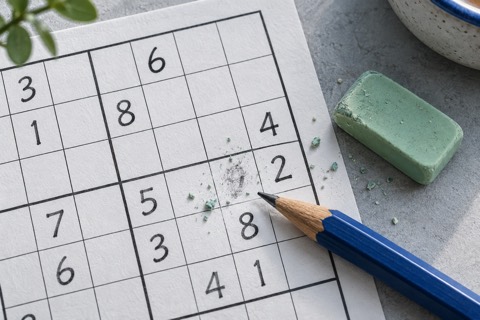
In DaySudoku, use Notes to remove a candidate by tapping it again. Notes are manual: the game does not automatically find pairs or clean up neighboring notes. Turn Notes off only when you have a justified final answer.
If no pair helps, move on. Not every position contains one. Try a simpler scan, take a short break, or check an earlier uncertain entry.
Do the two cells have to be next to each other?
Can I fill one of the pair's digits straight away?
What if there is nothing to erase outside the pair?
Another way to use notes: follow one digit from a box into a line. Or head back to today’s Sudoku, with one more way to look at the board.