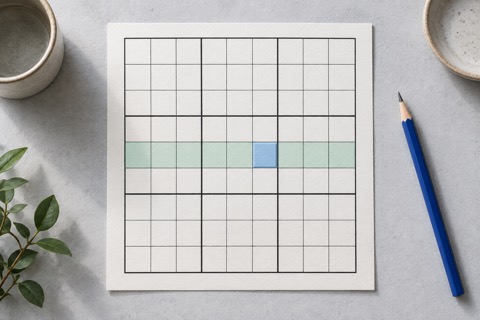
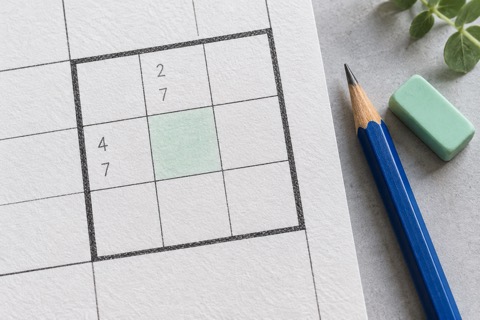
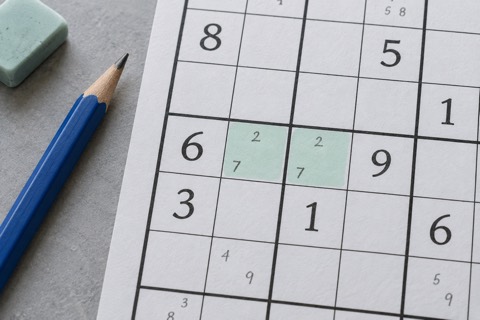
Follow one number. Find a new opening.
A box can tell you something about a whole line, even before you know its next answer. Follow one digit and see what opens up.
Back to today's puzzle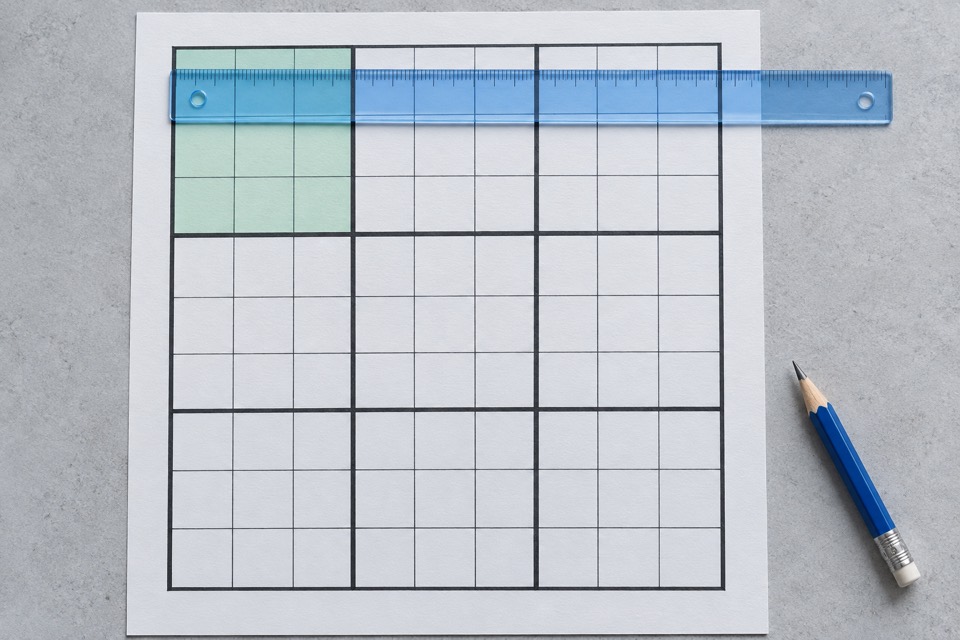
Look at one digit, not every note
Choose an unfinished 3x3 box and one digit it still needs. Check every empty cell against its row and column. Where could that digit still go?
If every possible place in the box lies on one row, that row’s copy of the digit must be inside the box. You can remove the digit’s notes elsewhere in that row. The same idea works with a column.
This is the pointing form of locked candidates: a pointing pair for two possible cells, or a pointing triple for three. You are ruling out positions, not choosing a final answer. SudokuWiki’s intersection-removal reference explains this shared-box-and-line rule.
Read the diagrams
These are independent teaching diagrams, not today’s puzzle. Each shows just one digit’s notes. Inside the tinted box, all its possible positions are shown. Outside that box, only a few relevant notes are shown; unmarked cells there are not necessarily ruled out. Other digits and givens are omitted.
The numbers above and beside the grid label columns and rows. They are not puzzle entries. A note inside the grid is a possibility, not a filled answer.
A box points along a row
In this example, the top-left box still needs 7. Its only two possible homes are both in row 1. Can either of the other 7 notes in that row survive?
In the top-left box, 7 can only go in row 1, column 1 or 3. Other shown 7 notes: row 1, columns 5 and 8; row 2, column 6.
See the answer & why
Remove 7 from row 1, columns 5 and 8. Whichever of the two box cells becomes 7, row 1 gets its 7 inside that box. The other two row-1 notes cannot be answers. Keep both box candidates and the note at row 2, column 6.
Keep the two notes inside the box. This deduction does not tell you which of those two cells will be 7. Also leave the note on row 2 alone: it is outside both the box and the affected row.
Turn the idea down a column
Now look at the top-middle box. All three possible homes for 4 sit in column 5. Three possibilities can be just as useful as two when they stay on the same line.
In the top-middle box, 4 can only go in column 5, rows 1, 2, or 3. Other shown 4 notes: row 4, columns 5 and 7; row 8, column 5.
See the answer & why
Remove 4 from column 5, rows 4 and 8. Column 5 must get its 4 from the top-middle box. The two notes below that box can go. Keep all three box candidates; this does not choose between them. The note at row 4, column 7 is unaffected.
You can remove candidates without immediately filling a cell. After the removal, check whether another cell has just one possibility left. If not, look at another box; progress need not be dramatic.
One extra possibility changes the answer
Do not stop checking a box after finding two matching notes. A third possible position off their line can invalidate the whole deduction.
In the top-left box, 7 can go in row 1, column 1 or 3, but also in row 2, column 2. Other shown 7 notes: row 1, columns 5 and 8.
See the answer & why
No: the box also allows 7 in row 2. If row 2, column 2 were 7, the box would not supply row 1's 7. Either outside note in row 1 could still be possible. This pattern gives no elimination; check the whole box before deleting a note.
Here, row 2 gives the box another way to hold its 7. That leaves room for row 1’s 7 to be outside the box. The two notes at the top are not enough evidence to erase anything.
Try one careful scan
- Start with a box that has only a few empty cells.
- Pick one missing digit and check every possible home for it.
- Ask whether all those homes share a row or column.
- If they do, remove that digit only from other cells on that line, outside the box.
- Recheck the affected cells for a simpler next move.
In DaySudoku, candidate cleanup is manual. With Notes on, tap an existing candidate to remove it. Keep final entries separate from possibilities, and do not erase the candidates that established the pattern. The pencil notes guide covers the controls; Find your next move covers simpler checks.
Is this the same as a naked pair?
What if the box has only one possible place for the digit?
Can I remove other digits from those cells too?
Return to today’s puzzle and try following one digit through one box.