Sudoku terms, made simple
A few familiar words make a puzzle easier to talk about. Find the term you need, then get back to your next move.
Back to today's puzzleThe board
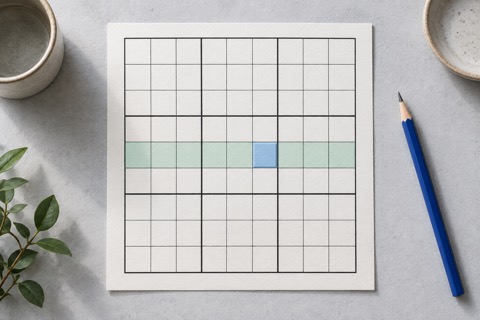
Rows run across; columns run down. In our guides, r4c5 means row 4, column 5, counting from the top left. The diagram marks that cell and its three units. It is a reference sketch, not today’s puzzle.
The outlined cell is row 4, column 5. Its row runs across, its column runs down, and its 3x3 box is tinted green. The 20 other cells in these three groups are its peers.
- Cell
One of the 81 squares in the board. A completed cell holds one digit, from 1 to 9.
- Row
Nine cells running left to right. Each row must contain 1 through 9 without repeats.
- Column
Nine cells running from top to bottom. Each column follows the same no-repeat rule.
- BoxAlso called a block or region
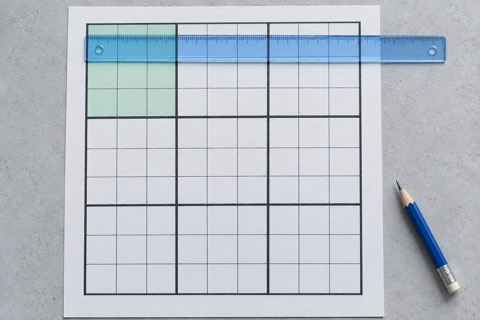
One of the nine 3x3 areas separated by heavier lines. Each box also needs every digit from 1 to 9.
- Unit
A row, a column, or a box. It is a convenient name for any one of those nine-cell groups, not a fourth kind of area.
- Peers
The other cells sharing a cell's row, column, or box. Each cell has 20 distinct peers; a cell belonging to two of those groups is counted only once.
- GivenA starting clue
A number supplied at the start of the puzzle. It is fixed, unlike a player entry. In DaySudoku you cannot change or erase a given.
Keep the givens, check your entries
Notes and possibilities
Keep what might be true separate from what you have established.
- Candidate
A digit that has not been ruled out for an empty cell. A candidate is a possibility, not a checked answer. A complete candidate list must keep every remaining possibility.
Work with candidates- Pencil notes
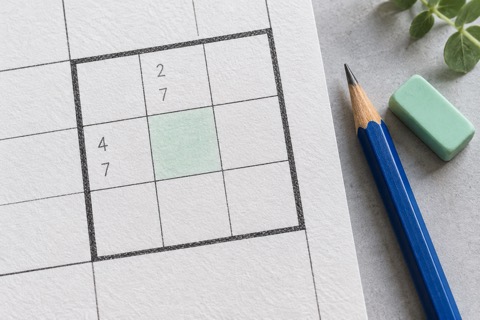
Small digits you record to remember candidates. Your notes can be incomplete or out of date. DaySudoku does not automatically generate notes or remove them from neighboring cells.
Add and remove notes- Elimination
Ruling out a candidate with a reason. Removing one possibility is progress even if several others remain; it need not produce a final number immediately.
Finding a certain move
You do not need to memorize technique names to solve a puzzle. Use these labels to find an explanation when you meet them in a guide.
- Naked single
A cell with only one remaining candidate. Ask: which digit can this cell contain? One note you happened to write is not enough; all other digits must really be ruled out.
See a naked singleA digit that has only one possible home in a unit. Ask: where can this digit go? That cell may still have other notes, which is why the forced placement can be easy to miss.
See a hidden single- Naked pair
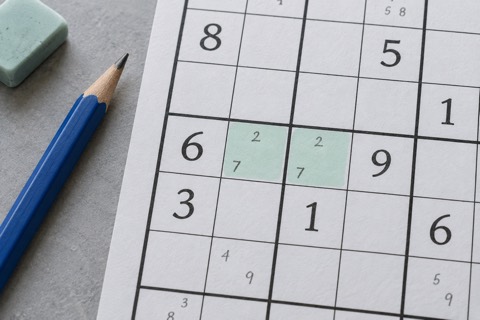
Two cells in one unit whose complete candidate lists are exactly the same two digits. Those two digits are reserved for the pair, but their order may still be unknown.
Explore the pair and a lookalike- Locked candidatesIncluding pointing pairs and triples
One digit confined to the overlap of a box and a line. In the pointing form, all its possible homes inside a box share one row or column, so it can be removed from the rest of that line outside the box.
Follow a digit from box to line
Warnings and help
A warning, a deduction, and a revealed answer do different jobs.
- Conflict
A repeated final digit in a row, column, or box. DaySudoku marks conflicting player entries red. No red warning does not mean an answer is correct; it only means no duplicate is currently detected.
Check a repeated digit calmly- Contradiction
A position that cannot lead to a valid solution, such as an empty cell with every digit ruled out. An empty note list alone is not proof: recheck your notes and the entries they depend on.
- Hint
In DaySudoku, a hint fills the correct digit in the editable empty cell you selected and clears that cell's notes. Successful hints are counted in your result. A hint is not a whole-board error check.
Review the game controls
What is the easiest way to remember naked versus hidden singles?
Are notes the same as answers?
Do I need all these techniques for today's puzzle?
For a first walkthrough, try Find your next move. For the full game rules, see How to Play.
Rule reference: Nikoli’s Sudoku rules. Single-candidate terminology: SudokuWiki’s beginner explanation. Definitions and the diagram here are written for DaySudoku.